Free client-side tool
Hooks Generator
Generate a valid Claude Code settings.json hooks block for lint gates, Stop checks, notifications, audit hooks, and secret blockers.
Open toolClaude Code engineering practice
A source-backed field manual for hooks, MCP, skills, subagents, CI, settings, permissions, and automation. Built for teams that want reviewable diffs, not AI theater.
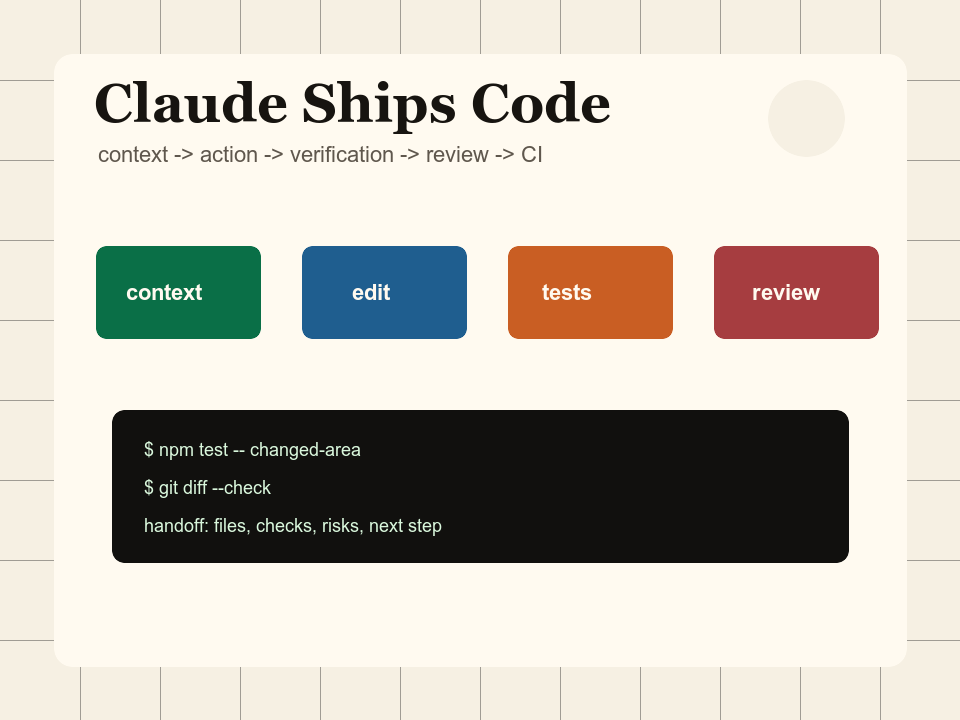
Signature experience · synthetic
A labeled synthetic Claude Code session you can step through: version check, a/verify skill as used in Code, a read-only MCP fetch plus a Stop hook, then a shipping check whose output is still in the session. Practice reviewing the transcript the way Claude Logs teaches — claims versus evidence — on a loop that is supposed to ship.
This site does not pin a CLI version. Run claude --version locally. Skill authoring belongs on Claude Has Skills. Forensic specimens belong on the Black Box.
Four beats
claude --version — unpinned. Confirm your binary, then read the changelog./verify loads a project SKILL.md. Authoring lives on Claude Has Skills.npm test -- hooks and git diff --stat before the summary.Key facts
claude-fable-5-1) defaults to High effort inside Claude Code and Medium on Claude.ai and Cowork, so budget cost and latency from the surface you actually run.claude-opus-5) is the general starting point, with a Fast mode at roughly 2.5x speed for 2x base price through Claude Code usage credits. Opus 4.8 is legacy.Defaults as of 2026-09-19
Model defaults are engineering configuration: they set session cost, how long an agent can run before it stalls, and how much latency a reviewer waits through. These are the current generally available options and the IDs to pin.
claude-fable-5-1Fable 5.1, shipped September 1, 2026. Most capable generally available model. High effort by default in Claude Code, Medium on Claude.ai and Cowork. $10/$50 per MTok, 1M context, cache reads at 2.5% of base input.claude-opus-5Opus 5, shipped July 24, 2026. The recommended starting point for most workloads. $5/$25 per MTok, default effort high. Fast mode runs ~2.5x faster at 2x base price via platform access or Claude Code usage credits.claude-sonnet-5Sonnet 5. $2/$10 per MTok for high-volume or routine agent work. The introductory rate became the standard rate; it did not rise on September 1, 2026.claude-haiku-4-5Haiku 4.5. $1/$5 per MTok, 200K context. Fastest and cheapest, suited to narrow mechanical subagent tasks rather than long-horizon repository work.Free tools
The tools are client-side utilities for Claude Code settings and workflow files. They target high-intent setup questions without replacing team review.
Free client-side tool
Generate a valid Claude Code settings.json hooks block for lint gates, Stop checks, notifications, audit hooks, and secret blockers.
Open toolFree client-side tool
Build a Claude Code permissions.allow, permissions.ask, and permissions.deny profile for a repo risk posture, tools, MCP servers, agents, and file boundaries.
Open toolFree client-side tool
Generate a .claude/commands markdown file with frontmatter, argument hints, allowed tools, workflow instructions, and verification expectations.
Open toolManual
The pages below stay inside Claude Code engineering practice. Adjacent topics link to sibling network sites instead of duplicating them.
A practical Claude Code tutorial for moving from first repository session to a verified, reviewable change without relying on vibes.
Operating modelSource-backed Claude Code best practices for teams: explore first, keep context small, verify work, use deterministic gates, and review diffs.
Project instructionsA practical guide to CLAUDE.md, settings scopes, project instructions, and local overrides for Claude Code engineering teams.
Settings examplesPractical Claude Code settings.json examples for permissions, hooks, slash commands, local overrides, and team-safe configuration.
Deterministic automationA practical Claude Code hooks guide covering lifecycle events, stop gates, formatting, tests, security, and when hooks beat instructions.
External systemsA source-backed guide to using Model Context Protocol with Claude Code for issue trackers, databases, monitoring, design tools, and internal APIs.
Lane discipline
Adjacent sites
Primary-source base
Core claims cite Anthropic's Claude Code docs, the official Claude Code Action repository, and Model Context Protocol documentation. Start withbest practices,the extension overview, andthe changelog.